Scope of application
Various impregnants including modified phenolic resin, furan resin and PTFE emulsion are available for selection to adapt to diverse working conditions involving acids, alkalis and organic solvents.
This equipment features high heat transfer efficiency, stable performance, good impact resistance and convenient maintenance. It is an ideal unit for cooling, condensation and heating processes.
Performance Characteristics
· Cooling water or circulating water is generally used on the shell side of this equipment to cool liquid materials flowing through the block side.
· If corrosive media pass through the shell side, a corrosion-resistant lining or coating can be applied to the steel shell, or an all-graphite structure can be adopted.
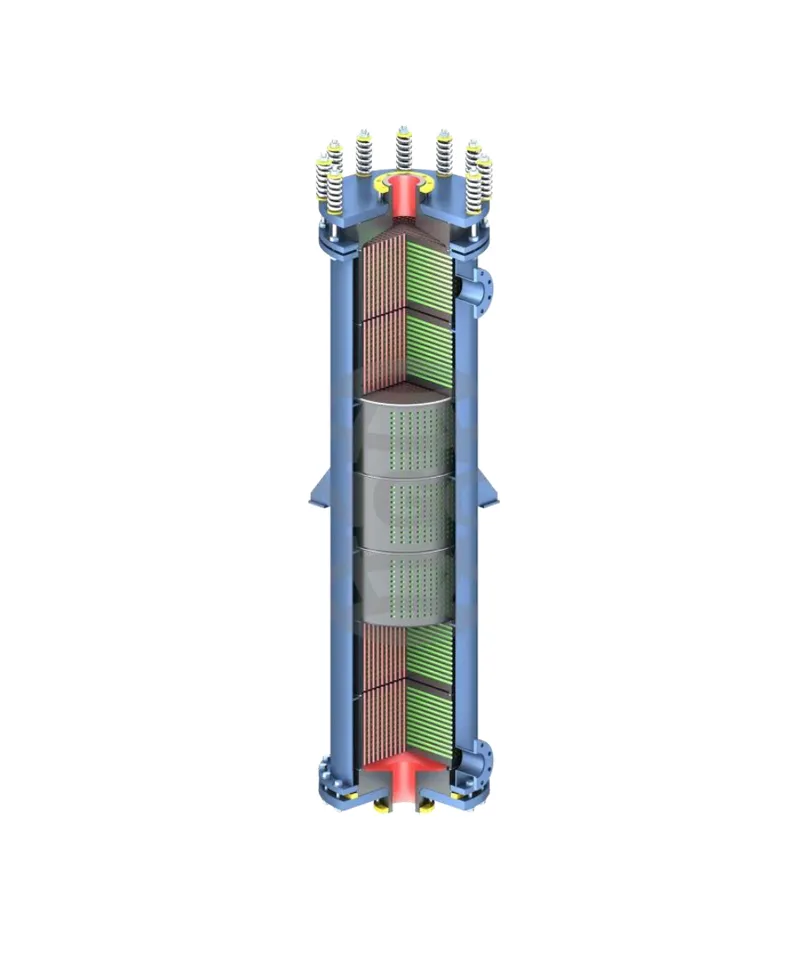
· This is an assembled graphite heat exchanger composed of multiple circular heat exchange blocks as well as upper and lower heads. Corrosion-resistant gaskets (Viton O-rings or PTFE gaskets) are installed between each heat exchange block.
· The unit is assembled with a steel shell and upper & lower metal cover plates. O-rings are fitted between the metal shell and graphite heads to allow free sliding between steel and graphite components. Springs are used to compensate for the differential thermal expansion between graphite and the steel shell.
· When condensing gaseous media, a gas-liquid separator shall be fitted at the bottom of the equipment for gas-liquid separation. Separators are available in graphite, rubber-lined steel and PTFE materials to match different working conditions.
· The equipment is normally installed vertically; horizontal installation is acceptable under special working conditions. The height of vertical mounting supports can be customized by customers according to site conditions. The jacket must be fully filled with cooling water prior to welding; otherwise, graphite blocks may be burnt out, impairing equipment integrity.
· All components feature good interchangeability. Adopting a modular detachable structure, the equipment can be assembled into units with various heat transfer areas using a limited range of standard parts. It facilitates disassembly, installation, cleaning, maintenance and transportation, bringing remarkable advantages for both production and after-sales servicing.
Technical Characteristics
| Process Side | Service Side | |
| Design Pressure | -0.1~1.2MPa | -0.1~1.2MPa |
| Design Temperature | 220℃ | 220℃ |
| Medium | Corrosive Materials | Water, steam, heat conduction oil or corrosive materials, etc. |
| Heat Exchange Area | 1~2000 m² | |
| Hole Diameter | 10, 12, 16, 18, 20 or larger | |
| Manufacturing Diameter | Φ100mm~Φ3100mm | |